Dynamics of Mobile Phone Taxation and Import Policy in Pakistan: An Exhaustive Analysis of the 2026-27 Finance Bill
Published by VerseZip Telecom Desk
Introduction: The Macroeconomic Context of the 2026-27 Fiscal Policy
The presentation of the Finance Bill 2026-27 represents a critical juncture in Pakistan's economic trajectory, arriving amidst signs of broader macroeconomic stabilization and rigorous structural reforms mandated by international financial institutions. As the Federal Board of Revenue (FBR) endeavors to meet ambitious revenue collection targets—projected to rise by nearly 19 percent to reach Rs. 14.13 trillion—the government is executing a delicate balancing act between expanding the documented tax net and stimulating economic growth through targeted tariff rationalizations. Within this expansive fiscal framework, the telecommunications sector, digital infrastructure, and consumer electronics market have emerged as primary focal points for legislative recalibration.
Effective July 1, 2026, the Government of Pakistan formally reduced the regulatory duty (RD) on imported high-end mobile phones by 20 percent. This policy shift, calculated to deliver an average consumer relief of Rs. 14,000 per premium handset, has dominated public discourse. However, analyzing this singular tariff reduction in isolation provides an incomplete understanding of the state's strategic intent. The 2026-27 budget introduces a profoundly complex matrix of taxation mechanisms designed to formalize the digital economy, protect the burgeoning domestic assembly sector (CKD/SKD), and safeguard vital import revenue streams.
This comprehensive report systematically dissects the mechanics of the new mobile phone taxation regime. It explores the inherent paradoxes of premium import revenues, the counterbalancing effects of aggressive customs valuation rulings, the revolutionary introduction of installment-based tax payments for device registration, and the broader implications of extending the tax net into the gig economy and e-commerce supply chains.
The Architecture of Tariff Rationalization and the 20 Percent Regulatory Duty Reduction
The reduction of the regulatory duty on imported mobile phones is fundamentally tethered to the broader National Tariff Policy (NTP) 2025-30, which aims to simplify trade facilitation, reduce anti-export bias, and enhance systemic efficiency across the import landscape. Under this overarching policy, the government has systematically slashed Additional Customs Duties (ACD) across thousands of tariff lines and capped the maximum Regulatory Duty at 20 percent for 359 distinct categories.
It is within this environment of strategic tariff liberalization that the 20 percent reduction in regulatory duty on high-end imported mobile phones was ratified. During extensive parliamentary review sessions held by the National Assembly Standing Committee on Finance, chaired by MNA Syed Naveed Qamar, the implications of this reduction were heavily debated.
FBR Chairman Rashid Mahmood Langrial formally informed the committee that the 20 percent RD reduction on premium imports would translate to a direct consumer relief of approximately Rs. 14,000 per device, taking effect at the commencement of the new fiscal year on July 1, 2026. However, the institutional posture of the Federal Board of Revenue regarding this specific concession was remarkably resistant.
In its policy recommendations for the Finance Bill 2026, the FBR leadership strongly advocated for maintaining the existing tax structure on imported mobile phones. The FBR characterized the prevailing regime as progressive, revenue-buoyant, and equitable over a realistic horizon, arguing that no restructuring of the rate bands was warranted. The core of the FBR's opposition to top-tier import duty cuts is rooted in the socioeconomic distribution of premium smartphone consumption. According to the board's analysis, premium imports are purchased almost exclusively by the most affluent consumer segments; therefore, dispensing relief in this specific category amounts to a regressive and costly transfer of wealth that depletes the national exchequer without providing meaningful relief to the broader, price-sensitive public.
The Revenue Paradox of Premium Smartphone Imports
To fully comprehend the FBR's initial reluctance to authorize the Rs. 14,000 premium relief, it is essential to analyze the stark asymmetry between import volumes and revenue generation in the mobile phone sector. Despite Pakistan fulfilling approximately 95 percent of its domestic mobile phone demand through local manufacturing and assembly, the remaining 5 percent consisting of completely built-up (CBU) imports exerts a disproportionate impact on federal tax revenues.
According to the latest import data scrutinized during the legislative sessions, the number of mobile phone units imported into Pakistan surged by 61 percent year-over-year, climbing from 0.64 million to 1.04 million units. Simultaneously, the declared import value more than doubled, registering a staggering 137 percent increase. This exponential growth in import value resulted in duty and tax collections from imported mobile phones surging by 136 percent, culminating in a total collection of Rs. 36.9 billion at the import stage.
The data reveals a highly skewed, top-heavy revenue distribution model that the FBR was desperate to protect. Flagship smartphones—defined predominantly as devices priced above the $500 threshold—account for only 16 percent of the total imported units. However, these premium devices contribute an overwhelming 58 percent of the total import tax revenue, generating Rs. 21.6 billion out of the total Rs. 36.9 billion collected. A significant portion of this revenue is driven by a single brand; Apple devices alone account for Rs. 21 billion of the import tax revenue.
The FBR explicitly warned the parliamentary committee that lowering taxes on these top-tier imported phones would effectively transfer revenue benefits to affluent buyers while causing a significant loss to government coffers. The FBR Chairman noted that any reduction in the slab for lower-priced phones would instantly create a shortfall of at least Rs. 1 billion, which would necessitate alternate revenue generation measures elsewhere in the budget. Instead, the FBR recommended that if fiscal relief must be provided to satisfy political and consumer demands, it should be strictly confined to the entry-level imported segment ranging from $31 to $200. This tier represents the only segment where tariff concessions would directly reach price-sensitive, first-time smartphone buyers at a low opportunity cost to overall government revenue.
Stratification of the Effective Tax Burden by Price Tier
The existing import duty structure in Pakistan is meticulously engineered to support a revenue-generating market rather than acting purely as a prohibitive import restriction. The taxation architecture is fundamentally progressive, with the tax burden escalating in tandem with the assessed value of the devices, thereby ensuring that the overall fiscal burden on lower-income households remains relatively modest.
Detailed briefings provided by FBR officials to the National Assembly Standing Committee on Finance outlined the highly stratified effective tax rates applied to mobile phones based on their assessed US Dollar (USD) value at the import stage. The tax liabilities per device vary astronomically across these tiers, ranging from a nominal Rs. 1,500 on basic feature phones to as high as Rs. 141,500 on ultra-premium flagship devices.
| Assessed Handset Value Range (USD) | Effective Tax Rate (%) | Proportion of Import Volume (%) | Sector Dynamics |
|---|---|---|---|
| Up to $30 | 25% | Declining Segment | Consumers shifting away from basic feature phones |
| $31 to $100 | 36% | ~44% | Highest volume segment, budget-conscious users |
| $101 to $200 | 40% | Moderate Volume | Segment recommended for targeted relief |
| $201 to $350 | 38% | Moderate Volume | Premium mid-range sector |
| $351 to $500 | 40% | Low Volume | Entry point for legacy flagship devices |
| Above $500 | 41% | 16% | Generates 58% of total revenue; dominated by Apple and Samsung flagships |
Source: Presentations by FBR officials to the National Assembly Standing Committee on Finance and Revenue.
Across all imported handset categories, the average effective tax burden currently stands at approximately 39.6 percent. During the parliamentary proceedings, these steep effective tax rates drew intense scrutiny. Committee member Hina Rabbani Khar questioned the underlying policy rationale behind the prevailing taxation structure on imported mobile phones. She raised profound concerns regarding whether the primary objective of this high tax regime was genuine revenue generation or the deliberate protection of specific commercial interests within the domestic assembly market. Lawmakers argued that consumers should not be subjected to such excessive financial burdens when purchasing essential communication devices, particularly in an increasingly digitized economy where mobile connectivity is critical for education, commerce, and daily life.
Customs Valuation Rulings: The Strategic Counterbalance
While the statutory 20 percent reduction in regulatory duty provides a highly publicized, nominal relief of Rs. 14,000 on high-end phones, the Federal Board of Revenue employs a powerful secondary administrative instrument that heavily dictates the final tax liability: Customs Valuation Rulings. The interplay between statutory duty reductions and administrative valuation hikes reveals the true complexity of Pakistan's import taxation strategy.
Under Section 25A of the Customs Act, 1969, the Directorate General of Customs Valuation possesses the statutory authority to determine and fix standard "Customs Values" for imported goods. These rulings serve as administrative benchmarks to prevent under-invoicing, reduce valuation disputes at the clearance stage, and ensure uniform duty assessment across all national collectorates. Crucially, if the invoice price or declared value of an import exceeds the set customs valuation, duties and taxes are applied on the higher amount; however, if the declared value is lower, the fixed customs value acts as an absolute floor for tax calculation.
In April 2026, ahead of the budget finalization, the Directorate issued Valuation Ruling No. 2070/2026, which formally rescinded and replaced the earlier Ruling No. 2035/2026 issued in January. This new ruling instituted a massive upward revision in the assessed Cost and Freight (C&F) value of 62 models of older and used mobile phones. The ruling specifically targets devices imported in commercial quantities without original packaging or accessories, stipulating that such phones must have been activated at least six months prior to export.
This administrative maneuver acts as a highly effective fiscal counterbalance to the 20 percent RD reduction. By artificially elevating the base USD value upon which the entire cascade of taxes—including Customs Duty, Additional Customs Duty, Regulatory Duty, and Sales Tax—is calculated, the absolute tax payable remains restrictively high, thereby neutralizing much of the statutory relief intended by the legislature.
Reassessment of Apple iPhone Customs Values
The comparison of the data between the January 2026 ruling (R-2035) and the April 2026 ruling (R-2070) demonstrates a systematic and aggressive increase in the assessed value of Apple devices. The data indicates that the FBR sought to capture more value from the lucrative secondary market for iPhones, which remains highly active in Pakistan.
| Apple iPhone Model | Previous Customs Value (R-2035) | New Customs Value (R-2070) | Absolute Increase (USD) | Percentage Increase |
|---|---|---|---|---|
| iPhone 15 Pro Max | $460 | $505 | $45 | +9.78% |
| iPhone 15 Pro | $390 | $472 | $82 | +21.03% |
| iPhone 15 Plus | $320 | $390 | $70 | +21.88% |
| iPhone 15 | $310 | $378 | $68 | +21.94% |
| iPhone 14 Pro Max | $360 | $413 | $53 | +14.72% |
| iPhone 14 Pro | $290 | $350 | $60 | +20.69% |
| iPhone 14 | $210 | $275 | $65 | +30.95% |
| iPhone 13 Pro Max | $295 | $374 | $79 | +26.78% |
| iPhone 13 Pro | $225 | $293 | $68 | +30.22% |
| iPhone 13 | $170 | $225 | $55 | +32.35% |
| iPhone 12 Pro Max | $215 | $274 | $59 | +27.44% |
| iPhone 12 Pro | $155 | $222 | $67 | +43.23% |
| iPhone 12 | $120 | $156 | $36 | +30.00% |
| iPhone 11 Pro Max | $145 | $211 | $66 | +45.52% |
| iPhone SE 2 | $25 | $52 | $27 | +108.00% |
Source: Directorate General of Customs Valuation, FBR, Ruling 2070/2026.
The data reveals a clear pattern: while the most recent flagship (the iPhone 15 Pro Max) saw a modest 9.78 percent increase, older models that form the backbone of the grey and refurbished import market (such as the iPhone 11 and iPhone 12 series) experienced valuation hikes ranging from 30 to 45 percent. The entry-level iPhone SE 2 saw an astronomical 108 percent increase, effectively erasing any potential benefit that the 20 percent RD cut might have provided to budget-conscious consumers seeking entry into the Apple ecosystem.
Reassessment of Samsung Galaxy and Android Customs Values
The valuation hikes were even more severe within the Android ecosystem, particularly for Samsung's flagship Galaxy S series. The Directorate's revised benchmarks indicate a belief that the earlier January ruling had severely undervalued slightly older, non-flagship Samsung models, especially those equipped with 5G capabilities.
| Samsung Galaxy Model | Previous Customs Value (R-2035) | New Customs Value (R-2070) | Absolute Increase (USD) | Percentage Increase |
|---|---|---|---|---|
| Galaxy S23 Ultra | $255 | $305 | $50 | +19.61% |
| Galaxy S23+ | $160 | $260 | $100 | +62.50% |
| Galaxy S23 | $140 | $250 | $110 | +78.57% |
| Galaxy S22 Ultra 5G | $160 | $260 | $100 | +62.50% |
| Galaxy S22+ 5G | $75 | $180 | $105 | +140.00% |
| Galaxy S22 5G | $80 | $130 | $50 | +62.50% |
| Galaxy S21+ 5G | $69 | $150 | $81 | +117.39% |
| Galaxy S21 5G | $50 | $110 | $60 | +120.00% |
Source: Directorate General of Customs Valuation, FBR, Ruling 2070/2026.
Other major Android brands were not spared. For instance, the OnePlus 12 valuation increased from $184 to $211, while the OnePlus 12R saw an increase from $105 to $176. By systematically elevating these base values, the FBR successfully engineered a scenario where the total quantum of duty and tax collected per handset will likely increase, despite the statutory reduction in the regulatory duty percentage. This dual-pronged strategy ensures that the FBR's revenue targets are protected against the potential erosive effects of tariff liberalization.
The Installment Paradigm: Revolutionizing Device Registration (DIRBS)
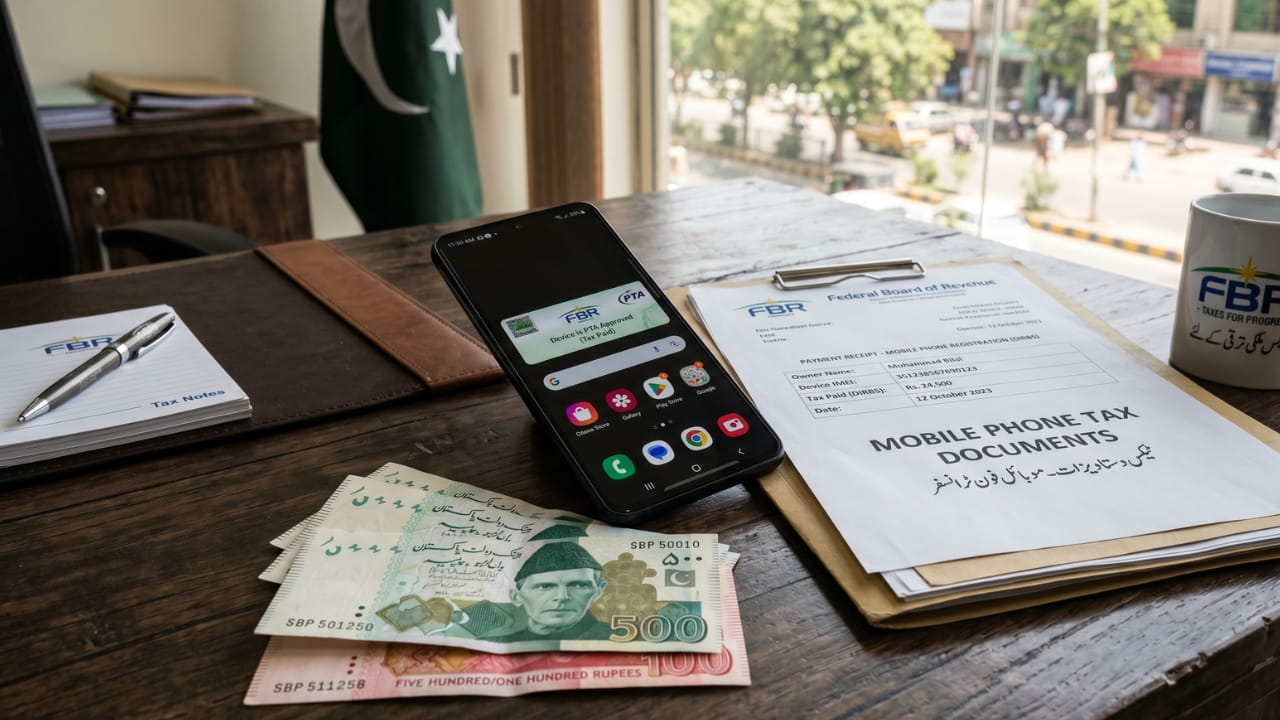
Perhaps the most structurally transformative amendment introduced in the 2026-27 Finance Bill is the modernization of the tax payment architecture for the Device Identification, Registration and Blocking System (DIRBS).
Operated by the Pakistan Telecommunication Authority (PTA), DIRBS is a central regulatory mechanism designed to combat mobile phone smuggling, control the use of stolen devices, ensure customs revenue collection, and link active cellular devices to a verified Computerized National Identity Card (CNIC) or Passport. Devices that fail to clear the requisite import taxes within a specified grace period are blocked at the IMEI (International Mobile Equipment Identity) level, rendering them incapable of accessing local SIM networks for calls, texts, or mobile data.
Historically, the steep, lump-sum upfront costs associated with DIRBS registration forced millions of users into the grey market. Consumers routinely utilized devices with "CPID" (Certificated Public ID) software patches—a method of tampering with device firmware to clone the IMEI of a cheaper, tax-paid phone onto an expensive, unregistered flagship. During the Finance Bill debates, committee members vociferously pointed out that millions of non-PTA-approved mobile phones were currently in use across the country solely because consumers could not afford the crippling lump-sum tax payments, which routinely exceed Rs. 100,000 for high-end devices.
Lawmakers argued passionately that the existing model was deeply flawed. They emphasized that consumer financing and installment facilities are globally standard practices, even for low-value consumer electronics, and that denying such mechanisms in Pakistan was counterproductive to revenue collection. The committee observed that smartphones are no longer luxury goods; they are essential digital infrastructure enabling education, financial inclusion, e-commerce, freelancing, and employment. Punitive, lump-sum taxation was criticized for actively undermining the government's "Digital Pakistan" vision by restricting access to the digital economy.
Operationalizing the PTA Tax Installment Framework
Responding to this overwhelming legislative consensus, the National Assembly Standing Committee on Finance mandated the introduction of an installment-based tax payment mechanism. Under the newly amended Finance Bill 2026, individuals liable to pay tax on imported mobile phone devices through the PTA's DIRBS will be officially permitted to clear their dues in structured installments. The primary condition attached to this facility is that the full payment must be realized within the financial year of import.
This strategic shift away from punitive, lump-sum collections toward a modernized financing model is expected to yield several profound macroeconomic benefits:
- Eradication of the Grey Market: By lowering the immediate financial barrier to entry for legal registration, users of software-tampered or smuggled devices are highly incentivized to regularize their hardware, thereby neutralizing the CPID black market.
- Predictable Revenue Streams: Instead of entirely losing tax revenue to smuggled, inactive, or patched devices, the government secures a steady, highly predictable, and broadened stream of income.
- Expansion of the Formal Digital Economy: By democratizing access to legal, fully functional communication tools, the state accelerates digital penetration among middle- and lower-income groups, facilitating broader participation in e-commerce and digital banking.
The Domestic Manufacturing Ecosystem: Challenges in the CKD/SKD Regime
The narrative surrounding mobile phone taxation in Pakistan is inextricably linked to the nation's aggressive domestic manufacturing ambitions. The country has executed a rapid transition from an import-reliant consumer market to a burgeoning domestic assembly hub. According to the FBR and the Pakistan Mobile Phones Manufacturers Association (PMPMA), an astonishing 95 percent of all mobile phones currently utilized in Pakistan are locally assembled, leaving a mere 5 percent market share to CBU imports.
This represents a monumental shift from previous years; historical data from 2020 indicated that out of an annual demand of 40 million units, only 13 million were assembled locally. Following the implementation of protective mobile manufacturing policies, over 30 local assemblers—including facilities producing global brands such as Samsung, Xiaomi, Tecno, Infinix, and Itel—now produce an estimated 2.5 million handsets per month. FBR Chairman Langrial emphatically defended this ecosystem, noting that the 95 percent local share is the true engine driving affordable digital access for Pakistan's young population.
To sustain this industrial momentum, the government has fiercely protected component-stage concessions under the Completely Knocked Down (CKD) and Semi-Knocked Down (SKD) regimes. By maintaining high tariffs on CBU imports while offering concessionary rates on imported parts and components, the state effectively forces international brands to establish local physical footprints.
The Accessory Taxation Anomaly
However, the local industry faces acute challenges regarding horizontal integration, specifically concerning ancillary components. The PMPMA has repeatedly petitioned the Engineering Development Board (EDB) regarding a highly detrimental loophole in the taxation regime: finished mobile accessories (such as chargers, earphones, and Bluetooth devices) can currently be imported at zero or highly concessional rates, whereas the raw materials required to manufacture these exact accessories locally face severe taxation.
Local manufacturers report that raw materials for accessories are subjected to a 20 percent customs duty, an 18 percent sales tax, and a 5.5 percent income tax at the import stage. Consequently, the local assembly of these accessories becomes more than 50 percent costlier compared to importing them in finished form. With a local production volume of 2.5 million mobile sets per month translating to an annual demand of up to 30 million chargers, assemblers argue that fixing this mismatched cascading tariff structure is vital for deepening the industrial base. Without long-term policy reversals, the incentive remains skewed toward importing finished accessories rather than investing in local production lines.
Fiscal Incentives for the Distribution Network
To provide downstream relief and stimulate the formal retail market, the Finance Bill 2026 introduces a critical concession for the domestic distribution network. The rate of minimum tax under sub-section (1) of section 113 of the Income Tax Ordinance has been drastically reduced to 0.5 percent for distributors, dealers, sub-dealers, and wholesalers of locally manufactured mobile phones.
This margin relief, extended alongside other fast-moving consumer goods like pharmaceuticals, fertilizers, and packaged foods, is intended to preserve the financial viability of businesses operating within the documented, compliant supply chain, thereby encouraging further formalization of the retail sector.
Retail Pricing Dynamics for Premium Devices in 2026
Despite the overwhelming dominance of local assembly in the budget and mid-range tiers, the ultra-premium segment (devices costing over $800) remains entirely import-dependent. Apple's iPhone lineup and Samsung's Galaxy S and Z series represent the pinnacle of this tier and continue to function as major revenue engines for the state.
The PTA tax structure for these devices remains bifurcated based on the registration pathway: Local CNIC (Computerized National Identity Card) versus Passport (Travel-based registration). Passport registrations traditionally carry a lower tax burden to accommodate overseas Pakistanis, tourists, and frequent travelers.
PTA Tax Structure on Apple iPhone 16 and 17 Series
With the Rs. 14,000 regulatory duty relief taking effect post-July 1, 2026, the overall compliance cost for the latest Apple devices will be nominally softened. However, due to their luxury classification and the aggressive upward revisions in FBR custom valuations, the baseline taxation remains formidable.
| iPhone 17 Model | CNIC Tax (PKR) | Passport Tax (PKR) |
|---|---|---|
| iPhone 17 | 154,293 | 128,766 |
| iPhone 17 Air | 175,949 | 151,322 |
| iPhone 17 Pro | 210,317 | 193,454 |
| iPhone 17 Pro Max | 213,631 | 182,710 |
Source: Pak Tax Calculator, 2026 Baseline. (Note: Final retail impact absorbs the Rs. 14,000 RD reduction).
| iPhone 16 Model | CNIC Tax (PKR) | Passport Tax (PKR) |
|---|---|---|
| iPhone 16 | 144,723 | 120,066 |
| iPhone 16 Plus | 152,379 | 127,026 |
| iPhone 16 Pro | 163,864 | 137,467 |
| iPhone 16 Pro Max | 183,005 | 154,868 |
Source: Pak Tax Calculator.
Android Flagship Market Pricing
In the Android ecosystem, the pricing of devices reflects a combination of statutory PTA taxes, high global MSRPs, and severe currency depreciation. Between January and March 2026, the Pakistani Rupee (PKR) depreciated approximately 4.2 percent against the USD, directly inflating retail prices by an average of 6 to 9 percent across mid- and high-end models.
| Flagship Model (2026) | Market Retail Price (PKR) | Target Demographic & Positioning |
|---|---|---|
| Samsung Galaxy S26 Ultra | Rs. 424,999 | Enterprise users, power users, enthusiasts |
| Samsung Galaxy S26 Plus | Rs. 364,999 | Premium users preferring non-stylus form factors |
| Samsung Galaxy S26 | Rs. 299,999 | Compact flagship market |
| Samsung Galaxy Z Fold 7 | Rs. 534,999 | Early adopters, ultra-luxury tier |
| Xiaomi Redmi Note 14 Pro+ | Rs. 144,999 | Premium-midrange, camera-centric users |
| HONOR X9d | Rs. 109,999 | Endurance/battery-focused premium users |
| Vivo V70 (256GB) | Rs. 179,999 | Design and portrait photography enthusiasts |
For devices like the Samsung Galaxy S26 Ultra (retailing at Rs. 424,999), a Rs. 14,000 reduction in regulatory duty constitutes a mathematically insignificant 3.2 percent discount on the final retail price. This reality strongly validates the FBR Chairman's initial assertion that broad tax cuts on the top-tier offer virtually no substantive advantage to the broader market. In stark contrast, a Rs. 14,000 reduction on an entry-level $150 device would represent a massive percentage shift, underscoring why the FBR had fervently recommended confining any relief to the $31 to $200 bracket.
Macro-Policy Context: Broadening the Digital Tax Net
The adjustments to mobile phone tariffs and import valuations do not exist in a vacuum. The Finance Bill 2026-27 is characterized by an unprecedented, aggressive push to formalize the digital economy and drastically widen the national tax base, reflecting intense pressures from macroeconomic stabilization programs and the International Monetary Fund (IMF).
Taxation of the Creator Economy and Social Media
In a landmark legislative move reflecting the shift from taxing physical hardware to taxing digital services, the Senate Standing Committee on Finance and Revenue approved the imposition of a 5 percent withholding tax on income earned through social media platforms, targeting creators on YouTube, TikTok, and other influencer streams.
Under the finalized framework:
- Annual social media income up to Rs. 600,000 remains entirely exempt from this specific withholding tax.
- Earnings falling between Rs. 600,000 and Rs. 1.2 million are subject to a 5 percent withholding tax.
- To ensure compliance, banking companies and non-banking financial institutions have been deputed as withholding agents, responsible for automatically deducting and remitting the tax directly to the FBR.
This policy officially acknowledges the explosive growth of Pakistan's internet economy. However, it generated immediate friction among policymakers who feared stifling digital entrepreneurship. Senators argued that foreign exchange inflows generated by freelancers and content creators are vital for macroeconomic stability and should be incentivized rather than penalized. Nonetheless, severe revenue imperatives ultimately superseded these concerns, firmly integrating the gig economy into the formal tax net. To mitigate public backlash, FBR Chairman Langrial explicitly clarified that sporadic, one-time transactions and micro-scale home-based businesses—particularly those operated by women—would be shielded from mandatory, complex online business registration requirements.
Digital Production Monitoring and E-Commerce Integration
Further tightening the operational noose on tax evasion, the Finance Bill 2026 mandates stringent digital production monitoring. Manufacturers of specified goods—which fundamentally includes locally assembled mobile phones—are strictly prohibited from removing or selling taxable goods without affixing physical tax stamps, barcodes, or integrating directly with the FBR's real-time video-based analytics and production monitoring systems. Companies that successfully integrate with the Board's real-time monitoring systems are proposed to receive a tax credit of 10 percent on the amount invested in the integration process.
Additionally, the bill introduces a comprehensive sales tax on e-commerce items. To capture this revenue effectively, the FBR has designated courier and logistics services as statutory tax collection agents, leveraging their access to the seller's final invoice to facilitate collection directly at the point of delivery. Furthermore, all digital vendors, including non-resident businesses selling goods to Pakistani consumers via online marketplaces, are now mandated to register in Pakistan.
Sector-Wide Tariff Rationalization and Dispute Resolution
Beyond telecommunications, the 2026-27 budget executes strategic tariff rationalizations across multiple industries to lower the cost of doing business. For instance, Additional Customs Duties (ACD) were reduced from 6% to 4% on 449 tariff lines, and eliminated entirely from 2% to 0% on 569 lines. In the automotive sector, total duties and taxes on vehicles up to 1800cc are proposed to be slashed from 156 percent to 74 percent. Simultaneously, a zero percent excise duty has been proposed on imported Electric Vehicles (EVs) priced under $75,000, signaling a pivot toward sustainable mobility.
To modernize the administrative interaction between the state and the taxpayer, the FBR is introducing a "faceless" audit, assessment, and appeal mechanism. This digital system ensures that hearings and the recording of statements are conducted electronically, keeping the identity of the adjudicating officer confidential to minimize corruption and bribery risks. Moreover, an algorithmic settlement mechanism has been introduced, allowing taxpayers to accept system-generated settlement offers and file revised returns without manual approval from a Commissioner, vastly accelerating dispute resolution.
Strategic Outlook and Future Implications
The synthesis of the extensive data surrounding the 2026-27 Finance Bill reveals a highly nuanced, multi-dimensional telecommunications and digital taxation strategy.
Key Strategic Takeaways
- Sustained Hegemony of Local Assembly: The FBR's staunch refusal to drastically slash CBU import duties across all tiers ensures that the 95 percent market share currently enjoyed by local assemblers will remain unchallenged. Global brands are virtually compelled to maintain or expand their SKD/CKD operations within Pakistan to remain competitive in the vital sub-$300 segment, which constitutes the vast majority of consumer demand. The 0.5% minimum tax rate for distributors further solidifies the viability of the local supply chain.
- The Illusion of Premium Relief: While the 20 percent regulatory duty cut on imported high-end phones generates highly positive consumer optics (a Rs. 14,000 relief), its actual economic impact is heavily blunted by administrative action. Because the Directorate of Customs Valuation significantly increased the baseline USD C&F values of used premium devices (via Ruling 2070/2026), the absolute tax payable remains prohibitive. Flagship phones will remain luxury status symbols, continuing to contribute disproportionately to the FBR's revenue targets.
- The Installment Catalyst: The most socioeconomically transformative policy in this cycle is undoubtedly the authorization of PTA tax installment payments. By transitioning from a punitive, lump-sum tax model to a modernized financing model, the state will likely catalyze a massive surge in legal device registrations. This will steadily erode the CPID grey market, improve cellular network security, and seamlessly integrate millions of previously disconnected users into the documented digital economy.
- Formalization of the Digital Periphery: The 5 percent withholding tax on social media earnings, the mandatory registration of e-commerce vendors, and the use of couriers as tax collection agents represent the final frontier of revenue collection. As physical hardware penetration reaches saturation, the state is pivoting its revenue generation strategies toward the intangible services, content creation, and income streams generated on those devices.
Conclusion
The 2026-27 Finance Bill's approach to mobile phone imports, digital infrastructure, and telecommunications taxation is a masterclass in fiscal maneuverability within a developing economy. By granting a calculated 20 percent regulatory duty reduction on high-end phones, the government provided a visible Rs. 14,000 relief that successfully appeased intense legislative and consumer pressure. However, by simultaneously hiking the foundational customs valuations of these exact devices and aggressively taxing the digital income they generate, the state brilliantly insulated its vital revenue streams, ensuring the exchequer does not suffer.
Ultimately, the preservation of the local assembly sector's competitive advantage, coupled with the revolutionary introduction of PTA tax installments, guarantees that Pakistan's trajectory toward mass digital inclusion remains intact. The interconnected policies enacted on July 1, 2026, will not spark a destabilizing flood of cheap premium imports, but they will cement a much more formalized, documented, and domestically resilient technology ecosystem capable of supporting the next phase of the nation's digital evolution.
Sources: KPMG Budget Brief 2026, ICMA Budget Compendium, FBR Official Notifications, National Assembly Finance Committee Proceedings, Dawn News, Business Recorder, The Express Tribune, Pak Tax Calculator, Directorate General of Customs Valuation Rulings.
Share this Telecom Analysis:
Leave a Comment
Your feedback is important to us. Submitted comments are kept private and are for internal review only.