China Launches World's First Floating Island: A Game-Changer for Deep-Sea Research
Published by VerseZip Current Affairs Desk
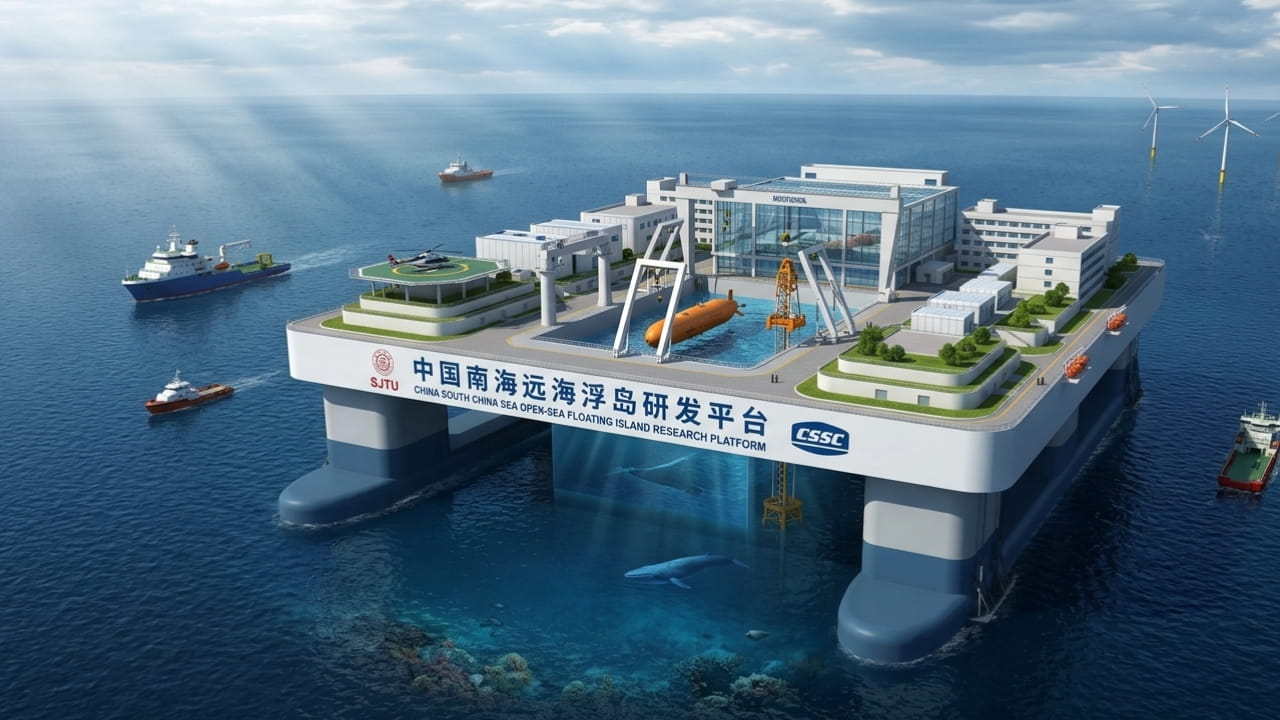
Imagine a floating research station the size of an aircraft carrier, capable of withstanding the most powerful typhoons while scientists explore depths of 10,000 meters below the ocean surface. This is no longer science fiction. It is now becoming a reality in Shanghai.
China has officially launched construction of the world's first ultra-large floating research platform, named the Open-Sea Floating Island, also referred to as Far-Sea Floating Island. This groundbreaking facility represents a major leap forward in marine science and engineering, positioning China at the forefront of deep-sea exploration.
The project, which falls under China's national science and technology infrastructure program, is being developed by Shanghai Jiao Tong University. Construction began in Shanghai on March 28, 2026, with an expected completion date of 2030.
What Exactly Is the Open-Sea Floating Island?
Despite its name, this is not an island where people will live permanently. Instead, it is a deep-sea, all-weather resident floating research facility, a high-tech scientific platform designed to stay at sea for long periods, even in the harshest conditions.
Think of it as a floating laboratory and testing ground combined into one massive structure. It is designed to support research across three major fields: marine equipment, testing heavy deep-sea machinery in real ocean conditions; marine resources, exploring and developing underwater minerals, energy, and other resources; and marine science, studying ocean ecosystems, climate patterns, and the origins of life.
The facility is a first of its kind globally. No other country has built a research platform of this scale and capability that can operate year-round in the open ocean.
Open-Sea Floating Island: Key Specifications
The Three Main Systems: How the Floating Island Works
The Open-Sea Floating Island is not a single floating chunk of land. It is a carefully engineered system made up of three interconnected components that work together to support scientific research.
System 1: The Main Facility Platform
This is the centerpiece, the floating structure itself. It is designed to remain stable in the open ocean, even during extreme weather. The main platform uses an innovative semi-submersible twin-hull design. This means it has two hulls like a catamaran that can partially submerge to keep the platform steady in rough seas. This design is critical for allowing scientists to conduct delicate experiments and lower heavy equipment into the water without the platform rocking dangerously.
System 2: Ship-Based Laboratories
The platform carries multiple onboard laboratories covering various research areas, including marine disaster monitoring, meteorological observation, and underwater physical environment research. These labs allow scientists to analyze samples and data immediately, without waiting to return to shore.
System 3: Shore-Based Support
Back on land, a dedicated support system provides logistics, maintenance, data processing, and coordination. This ensures that the floating island is never truly isolated and can receive supplies, new equipment, and personnel rotations as needed.
How Does It Compare to a Regular Research Ship?
| Feature | Traditional Research Ship | Open-Sea Floating Island |
|---|---|---|
| Maximum time at sea | 30 to 60 days | 120 days |
| Stability in rough seas | Rocks significantly | Exceptional stability with semi-submersible design |
| Equipment deployment | Limited by ship size | 300-tonne capacity via moon pool |
| Laboratory space | Limited | Extensive, multiple specialized labs |
| Crew capacity | 30 to 80 people | Up to 180 people |
What Will Scientists Actually Do There?
The Open-Sea Floating Island is designed to support a wide range of research activities across multiple disciplines.
- Deep-Sea Mining and Resource Development: The ocean floor contains vast deposits of valuable minerals. The platform will serve as a real-sea testing ground for deep-sea mining systems.
- Offshore Oil and Gas: Testing offshore equipment in actual ocean conditions rather than in controlled harbor environments.
- Marine Ecosystem Research: Studying how marine ecosystems change with seasons, including fish migrations and effects of climate change.
- Origins of Life: Hydrothermal vents and extreme environments may hold clues to how life first emerged on Earth.
- Typhoon Forecasting: Collecting real-time pressure, wind, and wave data to improve warning systems.
- Deep-Sea Equipment Testing: Testing ROVs, AUVs, and deep-sea drilling systems before commercial deployment.
Research Fields Supported
The New Institute: Deep-Sea Science and Engineering
Alongside the floating island project, Shanghai Jiao Tong University has established a new Institute of Deep-Sea Science and Engineering. The inauguration ceremony took place on March 27, 2026, with Shanghai's Mayor Gong Zheng and SJTU President Ding Kuiling jointly unveiling the institute.
The institute will follow an innovative model called construction while researching, construction while producing. This means research will begin before the facility is fully built, early results and discoveries will be shared as construction progresses, the institute will train the next generation of deep-sea scientists and engineers, and it will coordinate between the platform builders, researchers, and industry partners.
When Will It Be Ready?
Expected completion is 2030, approximately four years from the 2026 launch date. However, research will begin much earlier through the institute's construction while researching model.
- 2026 to 2028: Detailed design and initial construction of platform components
- 2028 to 2030: Assembly, testing, and sea trials
- 2030 onward: Full operational capability
The project is classified as a National Major Science and Technology Infrastructure project, the highest level of scientific investment in China's research ecosystem. This designation comes with significant funding and government support.
Why Does This Matter? The Bigger Picture
China is not building this floating island just for scientific curiosity. There are strategic, economic, and environmental reasons that make this project significant.
Competing in the Global Deep-Sea Race: The deep sea is the last unexplored frontier on Earth. Nations that master deep-sea technology will have advantages in accessing rare minerals and metals, understanding climate change through ocean data, and developing new marine industries.
Testing Before Commercialization: Before deep-sea mining can become a profitable industry, equipment needs to be tested. The floating island provides that testing ground.
Disaster Prevention: Better typhoon forecasting directly saves lives and reduces economic losses for coastal nations.
Understanding Climate Change: The ocean absorbs more than 90 per cent of the excess heat from climate change. Understanding how marine ecosystems respond to warming, acidification, and deoxygenation is critical for predicting our future.
"Shanghai is born from the sea and thrives because of the sea. This project supports China's marine power strategy and Shanghai's goal of becoming a modern maritime city."
Frequently Asked Questions
Is this really a floating island? Will people live on it?
It is called a floating island because of its size and capability, but it is actually a floating research platform, not a place for permanent habitation. Scientists and crew will live onboard during research missions up to 120 days at a time, but no one will live there permanently.
How big is it compared to an aircraft carrier?
The platform is roughly the size of a medium-sized aircraft carrier, approximately 200 to 250 meters long. The height is comparable to a 30-storey building.
Can it really survive a Level 17 typhoon?
Yes, according to official specifications. Level 17 is the highest category on the typhoon scale, with wind speeds around 250 km/h. The platform's semi-submersible design allows it to ride out storms that would sink ordinary ships.
What is a moon pool?
A moon pool is an opening in the bottom of a ship or floating platform that allows equipment to be lowered directly into the water below, without needing to lift it over the side. This is much safer and more stable, especially in rough seas.
How deep can it explore?
The platform supports research at depths of up to 10,000 meters, covering approximately 90 per cent of the ocean floor, including most deep-sea trenches.
Who is funding this project?
The Open-Sea Floating Island is a National Major Science and Technology Infrastructure project, funded by the Chinese government at the highest level. Shanghai Jiao Tong University is the lead implementing institution.
Is any other country building something similar?
No. According to all available sources, this is the world's first platform of its kind. Other countries have research ships and floating laboratories, but none have built an all-weather, year-round platform of this scale and capability.
When will the first research missions begin?
While the platform is expected to be completed in 2030, research has already begun through the newly established Institute of Deep-Sea Science and Engineering at Shanghai Jiao Tong University.
Final Thoughts: A Bold Step Into the Deep
The Open-Sea Floating Island represents a remarkable achievement in engineering and a bold vision for the future of ocean science. It is not just a bigger boat. It is an entirely new category of research platform.
By combining the mobility of a ship with the stability of a fixed platform and the endurance of a permanent station, China has created a tool that could unlock the mysteries of the deep sea in ways previously impossible.
Will it succeed? The engineering challenges are enormous. But if the platform delivers on its promises, it could accelerate deep-sea mining, improve typhoon forecasting, and help us understand the origins of life itself.
One thing is certain: the race to explore the last frontier on Earth just got a lot more interesting.
Sources: Xinhua News Agency, Global Times, Marine Insight, China.com.cn, Shanghai Association for Science and Technology, ScienceNet.cn, CCTV News.
Share this Current Affairs Update:
Leave a Comment
Your feedback is important to us. Submitted comments are kept private and are for internal review only.