China's Bold New Strategy to Break Free from Nvidia's CUDA Grip: Software-Defined Chips
Published by VerseZip Tech Desk
In a surprising shift that could reshape the global AI chip landscape, China is abandoning the idea of copying Nvidia's famous CUDA software. Instead, a top semiconductor expert has proposed a completely different path forward.
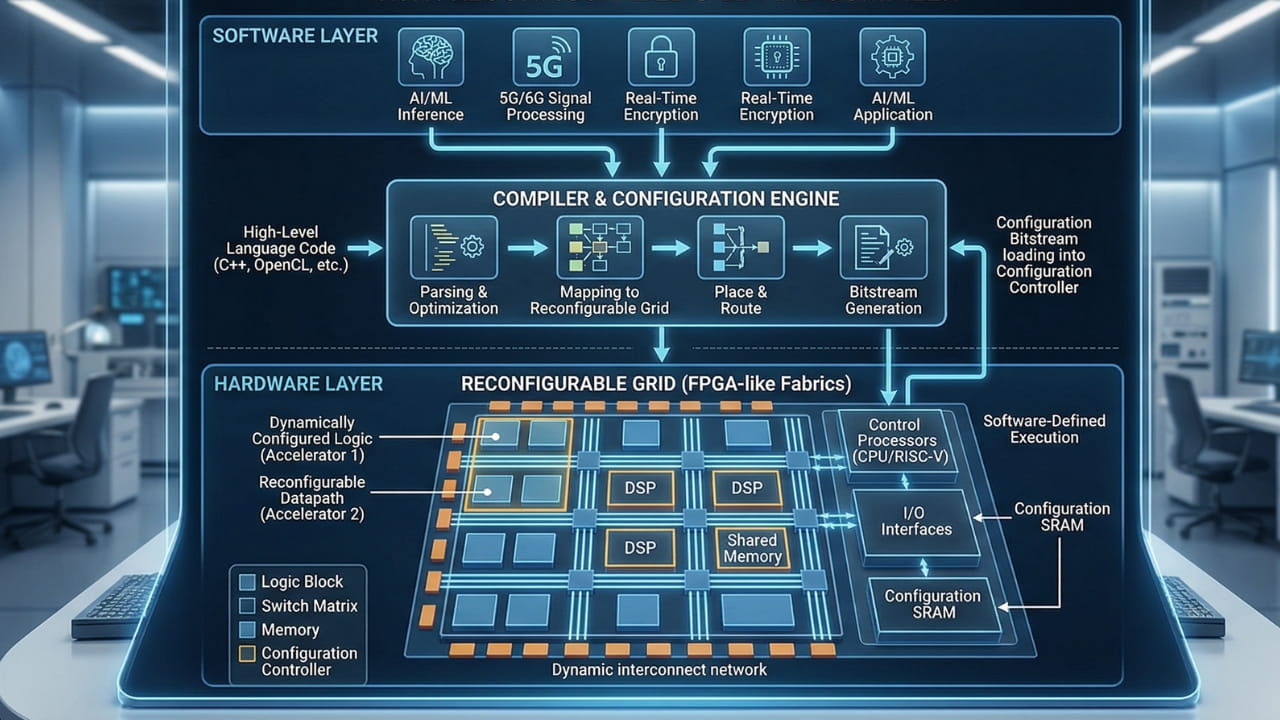
The plan is called software-defined chips, a concept that flips traditional chip design on its head. Rather than building hardware first and then writing software to fit, this approach lets the software dynamically reconfigure the chip's hardware on the fly.
The Problem: Nvidia's Impossible Moat
To understand why China is looking for a new path, you first need to understand Nvidia's strength. Nvidia CEO Jensen Huang has repeatedly described CUDA as the company's strongest moat. But what exactly is CUDA?
Simply put, CUDA is Nvidia's software ecosystem. It is the toolset that millions of AI developers around the world use to write programs that run on Nvidia chips. Because developers are so comfortable with CUDA, they naturally stick with Nvidia hardware.
This creates a powerful lock-in effect. According to Wei Shaojun, an executive at the China Semiconductor Industry Association, the global AI industry has become deeply tied to Nvidia's GPGPU architecture and CUDA ecosystem, creating what he calls a model-architecture-ecosystem triple dependency. China sees this as a major vulnerability. If access to Nvidia technology is restricted, the country's entire AI industry could be at risk.
The Traditional Approach: Why Copying CUDA Won't Work
The obvious solution would be for China to build its own version of CUDA, creating a competing software ecosystem that developers can switch to. But Wei Shaojun has a different view. He believes that building translation layers and separate ecosystems to replicate CUDA's success would require massive resources, and even then, success is not guaranteed.
"If we just follow existing chip architectures, we will likely only trail behind others and struggle to catch up," Wei warned during the SEMICON CHINA 2026 Global Semiconductor Industry Strategy Summit. He argues that the AI chip industry needs disruptive thinking, not imitation.
The Bold Alternative: Software-Defined Chips (SDCs)
Wei Shaojun has proposed shifting focus toward software-defined chips.
| Feature | Traditional GPU (Nvidia) | Software-Defined Chip |
|---|---|---|
| Hardware | Fixed design | Reconfigurable grid |
| Control | Hardware scheduler manages tasks | Compiler plans everything in advance |
| Flexibility | Low - hardware is fixed | High - software redefines the chip |
| Developer Lock-in | Strong (CUDA ecosystem) | Weaker - more adaptable |
In an SDC system, developers do not need a CUDA-like layer to run their workloads. Instead, the chips use a flexible grid that gets configured through instructions generated by a compiler. In traditional GPUs, a hardware scheduler decides what to do next. In SDCs, the compiler plans every single data movement down to the exact clock cycle. This is called deterministic compilation.
Real-World Examples: The Technology Already Exists
| Company | Architecture | Key Strength | Trade-off |
|---|---|---|---|
| SambaNova Systems | Reconfigurable Dataflow Unit (RDU) | Efficient for massive models (671B parameters) | Complex compiler requirements |
| Groq | Language Processing Unit (LPU) | Fast inference at small batch sizes | Memory constraints; needs many chips for large models |
| Cerebras | Wafer-Scale Engine | Massive on-chip memory (900,000 cores) | Expensive; limited to specific workloads |
The Strategic Advantage
The beauty of this approach is that it does not rely on advanced manufacturing processes. While China faces restrictions on accessing the most sophisticated chip-making equipment, SDCs offer a path forward through architectural innovation rather than relying solely on smaller transistor sizes. Wei Shaojun emphasizes that this could help China build an independent computing system despite limitations on advanced process nodes.
The Challenges: Why This Is Not Easy
Wei Shaojun is honest about the difficulties. The SDC approach comes with significant trade-offs.
- Complex Compiler Requirements: The compiler becomes the brain of the entire operation. It must perfectly schedule every instruction, every data movement, and every timing decision. This is an enormous engineering challenge.
- Routing and Branching Issues: Unlike traditional chips with predictable paths, SDCs must handle complex routing of data. Ensuring that everything arrives at the right place at the right time is difficult.
- Structural Changes: SDCs require completely rethinking how chips are designed. This means new tools, new testing methods, and new manufacturing approaches.
- Workload Limitations: Current SDC solutions like SambaNova and Groq are designed for specific workloads, primarily AI inference. They are not yet direct replacements for GPUs in all scenarios.
The Bigger Picture: China's Self-Sufficiency Push
The SDC proposal is part of a much larger trend. China is aggressively pushing for technological self-sufficiency in semiconductors.
Just this week, Alibaba and China Telecom launched a data center powered by 10,000 of Alibaba's own Zhenwu AI chips. This facility, located in Shaoguan in China's Guangdong province, is designed for AI training and inferencing and can support models with hundreds of billions of parameters. The message is clear: China is building its own AI infrastructure from the ground up.
What This Means for the Future
For Nvidia
Nvidia's CUDA moat has seemed unassailable for years. But if China successfully develops software-defined chips that do not need CUDA, it could create a parallel AI ecosystem that operates entirely independently of Western technology.
For Global AI Development
If the SDC approach proves successful, it could lead to more diverse AI hardware options. Developers might no longer be locked into a single vendor's ecosystem.
For China
Success here would mean reduced vulnerability to US export restrictions, an independent AI computing infrastructure, and potential leadership in next-generation chip architecture.
Wei Shaojun's Final Warning
Wei Shaojun closed his remarks with a powerful statement about China's approach to this challenge:
"Even if our own technology is not good enough at the start, it must still be used. Trial and error may not succeed, but without trying, we will certainly fall behind."
He added: "The maturity of technology requires real-world application scenarios to refine it, and the cultivation of an ecosystem requires the accumulation of time. This race tests not only technical strength but also strategic determination."
Frequently Asked Questions
What is CUDA and why is it so important?
CUDA (Compute Unified Device Architecture) is Nvidia's software platform that allows developers to write programs that run on Nvidia GPUs. It is important because millions of AI developers use it, which naturally locks them into using Nvidia hardware. Nvidia CEO Jensen Huang calls CUDA the company's strongest moat.
Why can't China just copy CUDA?
According to Wei Shaojun, a top Chinese semiconductor expert, building translation layers and independent ecosystems to replicate CUDA would require massive resources. He argues that simply following existing chip architectures will only keep China trailing behind. Instead, he advocates for disruptive thinking and new approaches.
What is a software-defined chip (SDC)?
An SDC is a chip whose hardware can be reconfigured by software. Unlike traditional chips with fixed functions, SDCs use a flexible grid that gets configured through instructions from a compiler. The compiler plans every data movement down to the exact clock cycle, an approach called deterministic compilation.
Are there real examples of this technology working?
Yes. Companies like SambaNova Systems with its Reconfigurable Dataflow Unit and Groq with its Language Processing Unit have built chips using similar principles. SambaNova claims that 16 of its chips can replace 320 GPUs for certain AI workloads.
What are the main challenges with SDCs?
The main challenges include complex compiler requirements where the compiler must perfectly schedule everything, routing and branching issues to ensure data arrives correctly, structural changes in rethinking traditional chip design, and workload limitations since current SDCs work best for AI inference.
Could this strategy actually work?
It is possible but very challenging. Wei Shaojun acknowledges the difficulties but argues that China must try. He famously stated that trial and error may not succeed, but without trying, they will certainly fall behind. The success will depend on whether China can overcome the significant compiler and engineering challenges.
Key Takeaways Summary
| Aspect | Key Point |
|---|---|
| The Problem | Nvidia's CUDA ecosystem creates strong vendor lock-in |
| The Strategy | Develop software-defined chips (SDCs) instead of copying CUDA |
| How It Works | Compiler plans all data movement; hardware is reconfigurable |
| Real Examples | SambaNova (RDU) and Groq (LPU) |
| Main Challenge | Extremely complex compiler technology |
| Expert Quote | "Without trying, we will certainly fall behind" – Wei Shaojun |
The Bottom Line
China is not trying to beat Nvidia at its own game. Instead, it is trying to change the game entirely. By focusing on software-defined chips that can be reconfigured dynamically, Chinese researchers hope to bypass the CUDA lock-in that has kept the AI industry tied to Nvidia for years.
The challenges are enormous. The compiler technology required is incredibly complex. But as Wei Shaojun argues, the alternative of simply accepting dependence on Western technology is worse.
Whether this bold strategy will succeed remains to be seen. But one thing is certain: the global AI chip race just got a lot more interesting.
Share this Tech Update:
Leave a Comment
Your feedback is important to us. Submitted comments are kept private and are for internal review only.