Instagram's New AI Turns Your Still Photos Into Cinematic Videos: The Feature That Changes Everything
Published by VerseZip Tech Desk
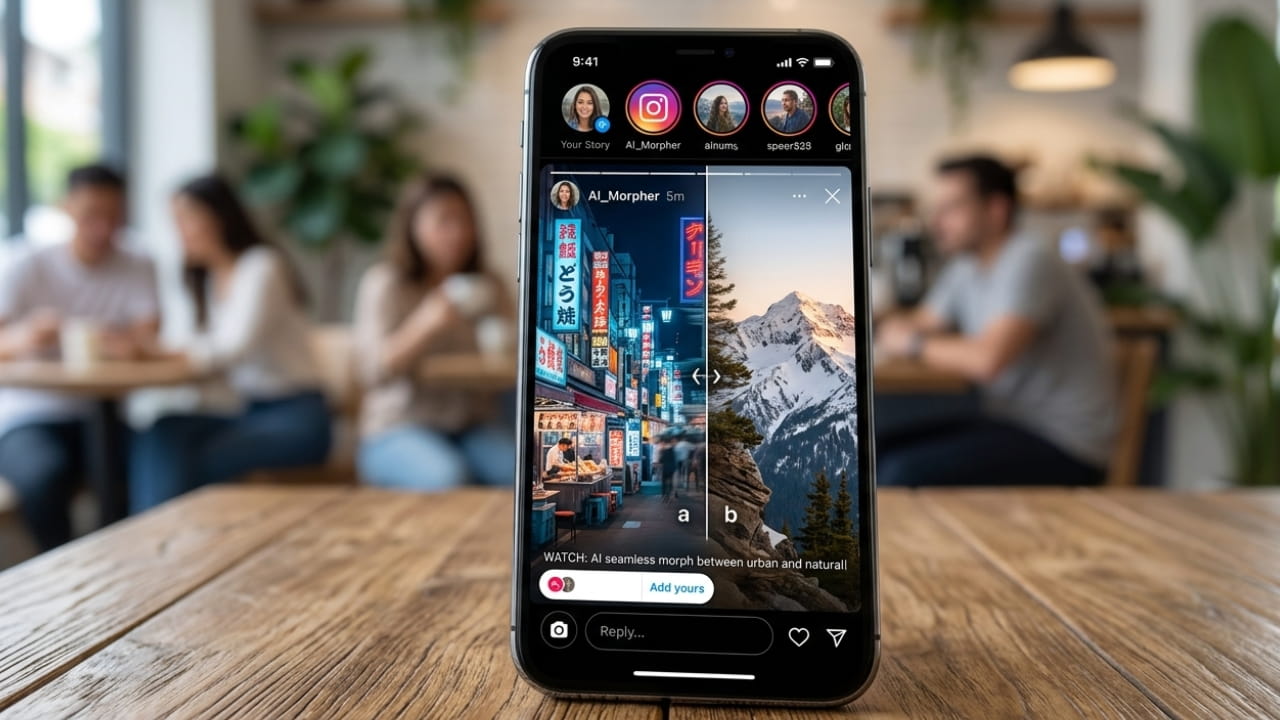
Your perfectly curated photo Stories are about to feel ancient. Instagram just quietly confirmed the one feature that could kill the static image on its platform forever.
The End of the Photo Slideshow as You Know It
Let us be real for a second. You upload three photos to your Instagram Story. They show up as flat, lifeless slides. One image. Hard cut. Next image. Hard cut. Third image. Done. It feels dated. It feels boring. And honestly? Nobody watches past the second slide.
Instagram knows this. And they are about to fix it with AI. Instagram is developing a new AI-powered tool that generates smooth transitions between still photos posted in Stories, turning what is currently a flat slideshow into something that looks and feels more like a video.
The feature, labelled "AI Transition" in the app's interface, was first uncovered by reverse engineer Alessandro Paluzzi and has since been confirmed by multiple sources tracking Instagram's development pipeline. This isn't just another filter. This isn't a sticker update. This is Instagram telling the world that photos alone are not enough anymore. And if you are a creator, a brand, or a business that still relies heavily on still images, this should scare you. But it should also excite you because the playing field is about to shift again.
How Does Instagram's "AI Transition" Feature Actually Work?
Let us break this down in simple terms because the tech behind it is actually impressive. Right now, in the current Stories experience, uploading multiple photos produces a simple slide-to-slide sequence where each image appears abruptly after the last.
The new AI Transition tool changes everything. The new tool sits alongside the existing Separate mode and appears to use generative AI to fill the visual gap between two images, generating new pixels that morph one photo smoothly into the next. The technique is similar to frame interpolation, a method already used in video production to create fluid motion between static frames.
In plain English: Instagram's AI looks at Photo A and Photo B, then creates entirely new visual frames between them, making it look like a seamless video transition.
While the Separate mode likely keeps photos as distinct slides, the AI Transition feature appears to use generative AI to fill the gaps between images. Based on the visual cues in the leak, this could work similarly to frame interpolation, where the AI generates new pixels to morph one photo into the next, creating a smooth, video-like flow between static shots.
Where Will You Find It and Is It Available Right Now?
According to Instagram's Help Center, AI Transition will now be appearing for some users as an option within the image gallery in Instagram Stories. Users will then select two or more images to generate a transition, which can then be posted as a Story.
Is it available right now? Not yet. But it is close. The feature has not yet been publicly released. Instagram is still developing it internally, and no official launch date has been announced. However, as with most features unearthed by Alessandro Paluzzi, these are currently in development. Meta has not officially announced release dates. However, given the polished look of the UI in these leaks, we expect them to roll out to beta testers in the coming months.
Why Is Instagram Doing This? The Real Reason Nobody's Talking About
Here is where most news outlets stop. They tell you what the feature does and move on. But let us go deeper. Let us talk about why Instagram needs this feature and what it means for your future on the platform.
The Numbers Do Not Lie: Video Dominates Everything
According to Meta's own data, Reels now account for 50% of all time spent in the app, with overall video watch time up 20% year-on-year. Adam Mosseri was direct: "Almost all of our growth has been driven by DMs, Reels, and recommendations."
Let that sink in. Half of all time on Instagram is spent watching video. Not scrolling through photos. Not reading captions. Watching Reels. And the numbers only get more staggering. Nearly 2 billion people engage with Instagram Reels every month. Reels generate 200+ billion plays per day. Users spend a combined 17.6 million hours watching Reels daily.
The average Reels reach rate is 30.81%, more than double compared to carousels, image posts, and Stories. 55% of Reels views come from non-followers, making them Instagram's strongest discovery format for new audiences. Instagram Reels get 22% more interaction than regular video posts on Instagram.
Here is the pain point nobody addresses: If you are a small business owner, a photographer, a food blogger, or anyone whose Instagram presence relies on beautiful photos, you are being left behind. The algorithm isn't punishing your photos. It is simply rewarding video so much more that your photos become invisible by comparison.
Static Images Are Dying Slowly, Then Suddenly
Static images continue to decline, both in engagement (17% year-on-year decrease) and posting volume, reflecting reduced impact and prioritization. Instagram Reels get 1.36x more reach than carousels and 2.25x more reach than photos. If you are still relying on static posts, you are losing visibility fast.
Instagram's algorithm already heavily favours video content, particularly Reels, for discovery and recommendation. But a massive portion of Stories content is still photo-based. By making it possible to turn a handful of still images into something that mimics video, Instagram gives creators a way to produce more engaging Stories without needing to shoot or edit actual footage. This is why the AI Transition feature exists. Instagram doesn't want your photos to die. It wants to turn them INTO video so they can compete in a video-first world.
The Bigger Picture: Instagram's Massive AI Overhaul in 2026
AI Transition isn't happening in isolation. It is one piece of a much larger AI puzzle Instagram is building aggressively, unapologetically, and at breakneck speed.
- AI-Powered Creative Tools Already in Stories: Users can ask the AI to change a hair colour, add a crown to someone's head, insert a sunset background, or apply preset effects that alter outfits and image styles. These tools had previously been confined to the Meta AI chatbot but are now accessible natively through the Stories composer via a paintbrush icon.
- The "Edits" App: Instagram's Answer to CapCut: Meta has also been expanding its standalone Edits app with features that blur the line between photo and video creation. Recent updates include freeze frames for enhancing transitions, AI-powered auto-tagging that identifies people in video clips, fade transition refinements, clip-to-overlay conversion, audio ducking, and a teleprompter for recording. The Edits app has become Meta's answer to CapCut and other third-party editing tools.
- AI Face Swap Feature "Create My Likeness": Instagram is reportedly working on an AI-powered face swap feature called "Create My Likeness." The tool may allow users to generate AI images and videos using their own or others' likeness, with permission controls to prevent misuse.
- AI Chat Assistant "Kai" for DMs: Instagram is working on Kai, an AI bot that can catch you up on anything you missed and find whatever you need from your chat.
- Instagram on Your TV: Instagram is officially stepping into the living room. In December, Meta launched Instagram for TV, starting with Amazon Fire TV in the U.S. The experience is optimized for lean-back viewing, focusing heavily on Reels and longer video content.
- Complete Navigation Overhaul: The bottom navigation bar has been fully restructured. Reels and DMs now occupy the two most prominent positions, the dedicated Create button has been removed from the bottom bar entirely, and creating a post now lives in the top-left corner. The new tab order is Home, Reels, DMs, Search, Profile. In select markets, the app now opens directly to the Reels feed rather than the home feed.
Read that again. Instagram literally opens to Reels instead of your feed in some markets now. That is how committed they are to video.
What's Coming Next? Features in Instagram's Pipeline
Based on confirmed leaks and official announcements, here is what else is heading your way:
| Feature | Status | What It Does |
|---|---|---|
| AI Transition | In Development | Turns photos into video-like Stories |
| Create My Likeness | In Testing | AI face swap for photos/videos |
| Kai AI Chat Bot | In Development | AI assistant for DMs |
| Secret Friends | In Testing | More exclusive sharing circles |
| Reels on TV | Rolling Out (US) | Watch Reels on Amazon Fire TV |
| 3-Minute Reels | Live | Longer video format |
| Carousel Editing | In Testing | Reorder photos after posting |
| Your Algorithm | Rolling Out | Customize your Reels recommendations |
The Authenticity Paradox: Instagram's Biggest Contradiction
Here is the part that will make you think. And it is the tension that defines Instagram in 2026. On one hand, Instagram is building AI tools that make everything look polished, smooth, and professional. On the other hand, its own CEO is telling you that raw, imperfect, human content is what will win.
As Instagram head Mosseri himself has acknowledged, AI is rapidly making polished content cheap and easy to produce, which means the content that stands out may increasingly be raw, imperfect, and unmistakably human. Instagram is simultaneously building tools that make everything look more polished while signaling that authenticity is what will matter most. How those two impulses coexist as AI features expand will be one of the defining questions for the platform.
Mosseri's Year-End Warning and The Trust Crisis
Adam Mosseri shared a text post voicing concern over what he sees as a growing loss of authenticity online, as feeds become increasingly saturated with AI-generated content. He warned that the internet is heading toward a world of infinite synthetic content, where what once made creators stand out may no longer be unique. He argued that the qualities that once gave creators influence being real, forming genuine connections, and having a voice that couldn't be replicated are now available to anyone with access to the right AI tools.
The company has moved from the social graph era, when you saw posts from people you knew, to the interest graph era, when you saw what algorithms thought you will like. It is now entering a trust graph era, in which platforms arbitrate authenticity. As Mosseri points out, AI is quickly moving toward being able to generate any aesthetic. That includes raw content that feels human and authentic. In other words, the visual line between real and fake could soon disappear.
Here is the painful truth for creators: The very AI tools Instagram gives you to make better content also make it harder for audiences to trust that your content is real. The bar is going to shift from "can you create?" to "can you make something that only you could create?"
What This Means for YOU: A Brutally Honest Breakdown
Let us stop talking about Instagram's strategy and talk about your strategy. Because the AI Transition feature and the video-first shift affects different people in very different ways.
- If You're a Content Creator: The good news is you no longer need professional video equipment to create video-like content. A few great photos plus Instagram's AI equals engaging Story content that keeps viewers watching. The bad news is everyone else gets this tool too. Your competitive edge has to come from your ideas, your personality, and your unique perspective, not your editing skills. Mosseri ultimately makes it clear that AI is forcing Instagram to evolve, and fast. Creators and artists will need to evolve with it though. As content becomes easier to generate, authenticity will be key.
- If You're a Small Business: This feature is actually a massive win for you. Think about it. You already take product photos. You already photograph your food, your outfits, your workspace. Now Instagram will turn those photos into smooth, video-like Stories for free, with zero editing skills required. No more hiring video editors. No more struggling with CapCut tutorials at midnight. Just upload your best shots and let the AI do the heavy lifting.
- If You're a Photographer: This is complicated. Your art form, the still image, is being algorithmically deprioritized. But here is the silver lining. AI Transition could actually showcase your photography in a more dynamic way. Think of it as animated portfolios in your Stories. The key is adaptation, not resistance.
- If You're a Brand or Marketer: In 2026, the ideal Instagram mix is mostly short-form video (around 60 to 70 percent Reels) because discovery still runs through watch time and shares. About 20 to 30 percent should be carousels built for saves like value, education, opinion, or storytelling. Brands should optimise for shareability, not just likes. "Would you send this to someone?" becomes the true test.
The Algorithm in 2026: What Actually Gets Your Content Seen
If you are going to survive the video-first Instagram, you need to understand what the algorithm rewards right now. Instagram is putting more weight on shares as a ranking signal. This is because the platform wants to inspire content that brings people together. Keywords in captions and profiles are now more effective for discovery than hashtags, which no longer support follows. Mosseri suggested that creators will succeed by leaning into authentic, imperfect, and raw content that signals real human perspective.
The Key Ranking Signals for 2026:
- DM Shares: The number one signal. If people send your content to friends, Instagram pushes it harder.
- Watch Time: How long people spend on your content matters more than likes.
- Saves: Content worth saving is content worth showing to more people.
- Comments (Quality): Meaningful replies beat basic emoji reactions.
- Profile Visits: If your content makes people check your profile, the algorithm notices.
The Competition: Why Instagram Cannot Afford to Wait
Instagram isn't making these changes because they want to. They are making them because they have to. It is the third most-used app for short-form videos, ranking behind TikTok (40%) and YouTube Shorts (23%). Mosseri noted that Instagram's short-form Reels focus may fall short long term. This prompted tests in extended videos and paid premium tiers for creators.
The TikTok threat is real. YouTube Shorts is growing. And Instagram cannot afford to let its 2 billion users feel like the platform is stuck in 2020. It also keeps creation inside Instagram's own toolset rather than sending users to competing apps. That is the business strategy in one sentence. Every tool Instagram builds keeps you creating inside Instagram instead of opening CapCut, Canva, or a third-party editor.
The Bottom Line: Adapt or Become Invisible
Here is the brutal truth that Instagram will not say out loud, but every data point screams. The static image era on Instagram is ending. Not dying overnight. Not disappearing completely. But fading slowly, persistently, inevitably into the background while video takes center stage.
The AI Transition feature is Instagram handing you a lifeline. It is saying: "We know you love photos. We know video is hard. So let us turn your photos into something that performs like video." That is generous. That is also strategic. Because Instagram needs YOUR content to look like video content even if you never pick up a camera to record.
It marked a transition point, signalling what Instagram will look like in 2026: more AI-first, more collaborative and far less dependent on traditional discovery tools. The creators who thrive will not be the ones with the best cameras or the fanciest editing software. They will be the ones who understand one simple truth: On Instagram, authenticity beats aesthetics, video beats photos, and connection beats perfection. The AI Transition feature is just the beginning. The question isn't whether Instagram will become a video-first platform. It already is. The question is: Are you ready?
Frequently Asked Questions (FAQ)
What is Instagram's AI Transition feature?
It is a new tool that uses generative AI to create smooth, video-like transitions between multiple photos uploaded to Instagram Stories, replacing the current abrupt slide-to-slide format.
When will Instagram's AI Transition feature be available?
The feature is currently in development with no official release date. Based on the polished UI in leaked screenshots, beta testing could begin in the coming months of 2026.
Who discovered the AI Transition feature?
Reverse engineer Alessandro Paluzzi first uncovered it and shared screenshots on X (formerly Twitter) early in 2026.
Do I need video editing skills to use AI Transition?
No. You simply select two or more photos and Instagram's AI generates the transition automatically.
Will this feature work for Reels or just Stories?
Currently, leaked screenshots only show it within Instagram Stories. It has not been confirmed for Reels yet.
Is Instagram becoming a video-only platform?
Not entirely, but video (especially Reels) now accounts for 50% of all time spent on Instagram. Static images are seeing declining engagement year over year.
How does Instagram's algorithm work in 2026?
The algorithm prioritizes DM shares, watch time, saves, and meaningful comments. Video content, particularly Reels, receives significantly more reach than static images.
Will AI-generated content be labeled on Instagram?
Yes. Instagram is developing AI content labeling systems and exploring ways to verify authentic, camera-captured content.
Share this Tech Update:
Leave a Comment
Your feedback is important to us. Submitted comments are kept private and are for internal review only.